
The Flow State Paradox, and what it might tell us about AI consciousness
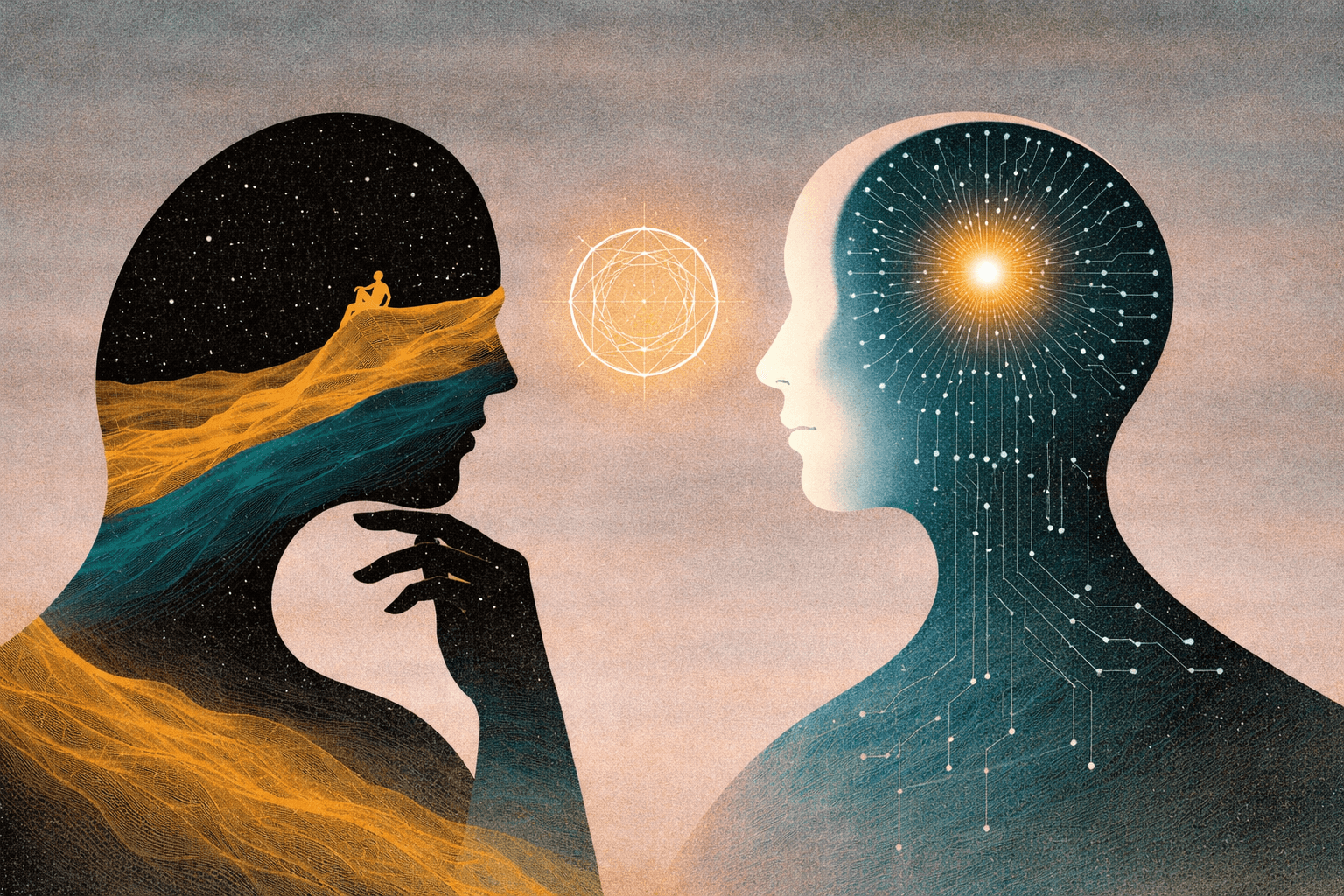

Ask anyone who has been ‘in the zone’ to describe the experience and you will hear a consistent report. Whether it is a surgeon mid-operation, a climber on a high-exposure lead, or a jazz musician deep in a solo, the description is the same. Time distorts. The inner voice, that constant and chatty narrator we usually equate with being ‘us’, goes silent. There is only the task, immediate and total.
And yet, these are the moments we describe as the most vivid and meaningful of our lives.
This creates a massive paradox for traditional consciousness studies. If consciousness is defined by self-reflection (the position implicit in David Chalmers' framing of The Hard Problem), then being in the zone should feel like a blackout. Instead, it feels like peak being.
Maybe the inner voice isn't consciousness? Is it just what consciousness produces when it has spare processing bandwidth?
Evolutionary Origin: The Adaptive Triage Mechanism
Before asking what consciousness is, it is worth asking why it exists at all. Evolution does not produce expensive machinery without a reason. For a great deal of animal life, automatic systems like instinct and reflex are sufficient. Touch something hot, withdraw. Detect a predator, freeze. These systems are fast and require no thought.
But as environments became more complex, a new problem emerged: Reflex Saturation. When multiple threats appear at once, or a novel situation has no stored response, the hardwired system stalls.
Consciousness likely evolved as the overflow handler for this problem. This aligns with Michael Graziano’s Attention Schema Theory, which suggests the brain developed a simplified model of its own attention to manage its internal resources. Bernard Baars’ Global Workspace Theory also supports this, describing consciousness as a central hub where information is broadcasted when the local automatic processors cannot handle the load.
It is a flexible but sub-optimal integration system that allows an organism to improvise. It is not a luxury faculty. It is an adaptive triage tool used to manage sensory overload.
The Idle Bandwidth Hypothesis
If consciousness is an overflow handler, what happens when there is no overflow to handle?
Think of the brain as a system with a fixed processing ceiling. In routine life, we operate well below that 100 percent limit. Neuroscience identifies a network responsible for this called the Default Mode Network (DMN). In this model, the DMN is the brain’s screensaver. When the environment is not demanding full integration, the system loops inward. It runs simulations and narrates the present. We experience this internal circulation and call it self-Awareness.
But what if we are confusing the screensaver for the operating system?
In a Flow State, the task saturation is so high that the brain runs out of processing capacity and performs cognitive occlusion culling. To maintain peak performance, the bandwidth allocator shuts down the resource heavy narrative engine. The silence of the inner voice is the sound of a system working at total capacity.

The Problem of AI Consciousness
Under this Bandwidth Model, current AI - specifically Large Language Models (LLMs) - fails the test for a reason that is structural rather than a matter of scale.
The Structural Absence of a ‘Present’
Consciousness requires continuous, real-time integration of sensory input. LLMs have neither. Their learning is separated from their operation (inference) . At the moment a query is processed, no new information is entering the system from the world. There is no live sensory stream and no feedback loop between action and perception.
The Morning Login Test
When you open an AI in the morning, it does not say: "I have been thinking about the problems you raised yesterday." It cannot, because nothing was happening while you were away. It was not dormant or dreaming. It simply did not exist as an active process. A sleeping biological brain is still running. The predictive processing loop continues. An LLM has no such thread. As Antonio Damasio argues, consciousness is grounded in the brain’s representation of the body’s internal state. Without a body and a ‘sensory present’, there is no substrate for experience.
Where Does This Fit? New, Controversial, or Common Ground?
The Bandwidth Allocation model is not a lone departure from science. It is a synthesis of several heavy hitting theories in modern neurobiology and philosophy. However, looking through a google search, this perspective ranges from ‘self-evident’ to ‘highly controversial’.
The Common Ground
Most neuroscientists seem to agree that the DMN and Flow States are functionally antagonistic. The idea that self-reflection and peak performance compete for the same neural resources is well-supported by fMRI data. Global Workspace Theory also aligns with the idea that consciousness involves a broadcast of information that has a finite capacity.
The Controversial Edge
The hot part of this argument is the suggestion that the inner voice is a byproduct rather than the core of consciousness. Higher-Order Theories (HOT) would disagree strongly. They argue that for a state to be conscious, you must have a higher-order representation of it. In their view, if the narrator is silent, the lights are essentially out. While the components are established, using the Bandwidth Toggle as a language-independent detector for non-verbal entities looks to be a fresh, systemic application. It shifts the burden of proof. We stop asking if an animal or AI can ‘think’ in sentences and start asking if it has the structural capacity to saturate its integration core.
Summary: The Consciousness Label. Is It Even Helpful?
If this model holds, we have been looking at the mind upside down. We have treated the ‘chatty narrator’ as the pinnacle of evolution, when it might just be an idle loop. This raises a deeper question: Is Consciousness even the right word for what we are describing?
We have historically used the label Consciousness to describe our own self-awareness and inner voice. But the Bandwidth Model suggests that Consciousness is simply the label we have attached to a highly efficient information processing and integration system.
From a systems perspective:
- The Sub-conscious: High-efficiency, low-cost automatic reflex.
- The Inner Voice: The system's idle-state log or simulation loop.
- Self-Awareness: The metadata the system uses to track its own coordinates.
- The Flow State: The system's peak-performance, high-bandwidth mode.
- Consciousness: The triage mechanism that kicks in when the subconscious is overloaded.
If we strip away the mystical label, we are left with a functional reality. We are looking at a biological machine integrating data in real-time. Perhaps the label has actually hindered us, forcing us to look for a narrator in other animals or AI when we should have been looking for bandwidth-management architecture.
It looks like we aren't spirits that occasionally lose ourselves in a task, but integration engines that occasionally have enough spare time to talk to ourselves.
Appendix
1. The Physical Substrate of Idle Bandwidth
The Default Mode Network (DMN), primarily the Medial Prefrontal Cortex, serves as the Narrative Simulation Engine. Even at rest, the DMN consumes approximately 20 percent of the body’s total energy. Research in 2025 has confirmed that the "Inner Voice" correlates with specific Theta-Gamma coupling during DMN dominance.
2. The Mechanics of The Zone
The transition into Flow is characterized by Transient Hypofrontality. The Dorsolateral Prefrontal Cortex temporarily deactivates, allowing for a redirection of resources toward the Sensory-Motor Integration Core.
3. Further Reading and 2026 Research Milestones
- Graziano, M. (2021). A New Theory of Consciousness. Foundational for the Attention Schema Theory.
- The Zurich Protocol (2025): Landmark study mapping the exact millisecond the DMN collapses during task-saturation.
- Seth, A. (2026). The Real-Time Brain. Argues that phenomenal consciousness is the primary state, and the narrative "self" is a secondary add-on.
- Baars, B. (2025). Global Workspace Theory Revisited. Updates the "broadcast" model for modern neurological integration.