
The AI Wearable Ecosystem: Closer than you think. Socially acceptable?

For most of us, the smartphone has taken over ... camera, map, wallet, calendar, alarm clock, newspaper, the 'fountain of all knowledge' in our pocket. Now it's being asked to become something even bigger ... our personal AI assistant, apparently capable of doing almost anything better than the average human.
Yet we're all getting fed up with the constant in-and-out of the pocket, the frustrating two-thumb typing, the 'where's my phone?' anxiety. Quietly, we're aware of an addiction to a device we increasingly resent.
AI promises a genuine leap forward from here. Not an upgrade to the smartphone, but a replacement for the whole 'experience'. The prize waiting for the first company that cracks it is enormous. The race has started. This article looks at what's been tried so far, who's closest, what issues arise, and even what an AI wearable ecosystem might look like ...
A taxonomy of possible forms ...
The first question any designer must answer is where the device lives on the body. Each location needs different set of sensors, different processing and power requirements, and a different social contract with the people around you.
| Form factor | Key sensors / outputs | Social acceptability |
|---|---|---|
| Glasses | Camera, mic, display, bone-conduction audio | High - familiar accessory, but camera raises questions |
| Earbuds / headphones | Always-on audio, biometric sensing | High - already normalised |
| Ring | EMG gesture sensing, health monitoring | Very high - reads as jewellery |
| Wristband / cuff | Neural gesture capture, biometrics, haptics | High - watch convention |
| Pendant / neckband | 360° mic array, ambient camera | Medium - novel, camera-facing raises privacy concerns |
| Pen / stylus | Handwriting capture, gesture, ambient mic | Very high - reads as note-taking |
| Personal drone | Aerial camera, follow mode | Low - noise, regulation, and obvious surveillance |
| Surface hub | Shared mic array, camera, local compute | Medium - unobtrusive in form, but scope of capture unclear |
Form factors under active development across the AI hardware industry, April 2026. Acceptability ratings are qualitative.
The market has already delivered its first verdict. The Humane AI Pin glowed from a lapel and projected a laser display onto your hand. The Rabbit R1 was an orange wedge you held like a walkie-talkie. Both failed not because the technology didn't work, but because neither fit naturally onto a body or into a social situation.[1] The Humane Pin was discontinued in early 2025 after scathing reviews citing overheating and poor performance. It sold for $699 at launch and changed hands for $116 million in the liquidation.
The lesson isn't just aesthetic. Devices that look strange get scrutinised. A device that looks strange and has a camera pointing at everyone around you invites outright hostility.
Who's building what?
Meta: the current market leader
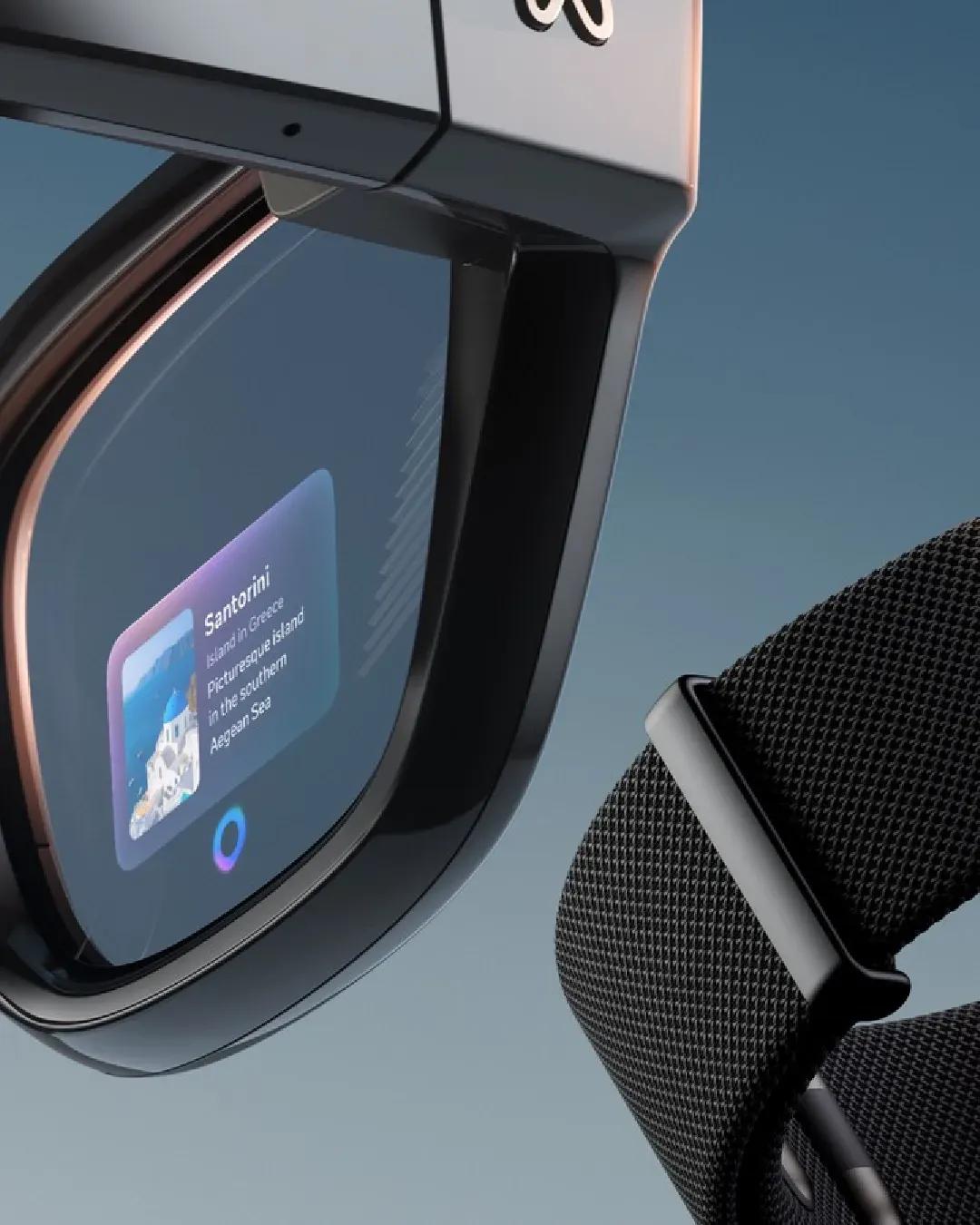 Meta is the only company that has shipped an AI wearable at genuine consumer scale. The Ray-Ban Meta glasses sold two million units by early 2025. The September 2025 launch of the Ray-Ban Display at $799 added a full-colour in-lens display: 600×600px, 20-degree field of view, 5,000 nits of brightness, visible in direct sunlight.[2] The companion Neural Band uses electromyography sensors on the wrist to detect subtle finger muscle contractions, enabling gestural control and handwriting recognition with no visible hand movement required.
Gen 3 glasses are in development for late 2026, targeting facial and object recognition, a Qualcomm Snapdragon AR chipset, and six to eight hours of mixed-use battery life.[3] The facial recognition capability in particular is already drawing scrutiny from regulators, for reasons we'll return to.
OpenAI and Jony Ive: the $6.4 billion bet
OpenAI acquired Jony Ive's hardware startup io for $6.4 billion in May 2025, making Ive head of design across both companies.[4] The first confirmed product is a smart speaker with an integrated camera, expected in early 2027, which uses facial recognition to learn who's around it and suggest goal-aligned actions. A second product, a screenless palm-sized audio-first ambient device, is also in development. OpenAI has consolidated its engineering and research teams specifically to overhaul its audio models for voice-first hardware, targeting conversational latency and natural interruption handling that current systems can't achieve.
The scale of the ambition
OpenAI's internal target is to ship 100 million units of its first AI device faster than any company has shipped 100 million of something new. The iPhone took approximately four years to reach that milestone from launch. Foxconn is already contracted.
Google's third attempt at glasses
Google confirmed in December 2025 that AI glasses are coming in 2026, in partnership with Samsung on hardware and Warby Parker and Gentle Monster on frames.[5] Two versions are planned: audio-only Gemini-integrated glasses, and a display variant showing navigation and live translation in the lens. The original Google Glass launched in 2014 and failed almost entirely on social grounds. The people wearing them were nicknamed "glassholes." Strangers would demand they be removed in bars and restaurants. The new version takes a deliberately different approach: fashion-first design, familiar frames, and AI branding rather than technology branding. Whether that's enough to solve a fundamentally social problem remains to be seen.
Apple: the quiet acquisition
Apple acquired Israeli startup Q.ai in early 2026 for approximately $2 billion, its largest deal since Beats.[6] Q.ai reads microscopic facial skin movements to detect silently mouthed words, emotional expressions, and physiological signals, without the user making any visible or audible gesture. Camera-equipped AirPods using infrared depth sensing are predicted for 2026. Apple's approach may be a game changer, in that the primary AI interface could effectively be invisible. It would operate on the wearer's own face rather than scanning the faces of everyone else in the room.
How you'll control it ...
Speaking out loud to a device is becoming an antisocial act. It announces to everyone nearby that you're consulting a machine, and leaks private information into public space. The designers working on next-generation AI hardware are converging on several input modalities that sidestep this.
Silent speech via subvocalisation. When you form words in your mind without speaking, the motor cortex still fires. Signals travel to the speech muscles; they just don't contract fully enough to produce sound. These ghost signals can be captured by electromyography sensors on the jaw or neck. MIT's AlterEgo project, commercialised in 2025, reads these signals and achieves near-silent communication: you think-speak to your device, nothing visible happens.[7] Cornell University's EchoSpeech system takes a different approach, bouncing inaudible sonar from a glasses frame across the face to read lip movements with around 95% accuracy.[8]
Neural gesture via the wrist. The Meta Neural Band detects the EMG signals your forearm produces when you make finger movements, even tiny ones. Neuranics' MiMiG wristband, shown at CES 2026, uses magnetomyography for even finer resolution. The Naqi Neural Earbuds, which won Best of Innovation at CES 2026, enable device control through head tilting and blinking, described as "a non-invasive alternative to a brain implant."[9]
The underrated pen. Holding a pen reads as note-taking in virtually every context where speaking out loud would be strange. Multiple rumours around the OpenAI/Ive device have pointed to a pen form factor. A pen with a microphone, an IMU, and wireless connectivity captures handwriting, ambient audio, and gesture input while appearing to any observer as someone simply jotting something down.
Gesture. The pointing, beckoning, dismissing and eyebrow raise of human communication carries enormous bandwidth, and current devices are blind to almost all of it. The touchless sensing market was projected at $15.3 billion in 2025; gesture recognition at $31.6 billion.[10] The first device that reads this fluently will feel genuinely new.
The social acceptance problem ...
When you wear an AI device with a camera and a microphone in a crowded street, in a café, in a meeting, at a party, you're not just making a decision about your own privacy. You're making a decision about the privacy of everyone within visual and audio range. They haven't consented to anything. They don't know what's being captured, processed, or retained. They have no idea whether the system is even active.
This is a fundamentally different problem from the smartphone camera. When someone raises a phone to take a photo, you can see it. The gesture is legible. An AI wearable that's always on, always listening, always watching through a lens that looks identical to ordinary glasses, is a different category of 'surveillance' entirely. It's invisible by design.
"Adoption has consistently favoured devices that resemble objects people already wear, which explains the traction of the Ray-Ban Meta glasses and the resistance facing pins, pendants and headsets."
The problem cuts deeper than the "glasshole" backlash that killed Google Glass. That was largely about perceived arrogance, tech people wearing conspicuous gadgets in public. The backlash coming for the next generation of AI glasses could be grounded in something more substantive: the legitimate objection of people who don't want to be continuously recorded, analysed, and potentially identified by a stranger's AI.
What does the law say?
The legal position varies dramatically by jurisdiction, and in most of them, the law hasn't caught up with the technology.
In the UK, any footage or audio that captures identifiable individuals counts as personal data under the Data Protection Act 2018 and UK GDPR. That means anyone wearing a camera-equipped AI device in public is, in principle, acting as a data controller — with all the obligations that brings: lawful basis for recording, purpose limitation, data minimisation, and secure storage.[11] The ICO's own guidance on body-worn video states that users should "provide sufficient privacy information to individuals before using BWV, such as clear signage, verbal announcements, or lights and indicators on the device itself."[12] In other words: yes, a light on the device indicating active recording is not just a design choice - it's what regulators expect. Facial recognition adds another layer. Processing biometric data to uniquely identify someone requires an explicit condition under Article 9 of UK GDPR. There's currently no domestic AI law governing this specifically, and UK police have been scanning millions of faces under guidance documents and common law interpretations with no primary legislation in place.[13]
In the EU, the picture is sharper. The EU AI Act's prohibited practices came into force in February 2025. Real-time remote biometric identification in publicly accessible spaces is banned, with narrow exceptions for law enforcement. Building facial recognition databases by scraping images from the internet or CCTV footage is banned with no exceptions at all.[14] The full high-risk AI system requirements, including those governing biometric identification, become enforceable in August 2026. An AI glasses product that identifies the faces of people walking past its wearer would, under a reasonable reading of the Act, be operating a prohibited system. The fines are up to €35 million or 7% of global annual turnover, whichever is higher.
In the US, the picture is a patchwork. There's no federal AI law. A handful of states and cities, including San Francisco, Boston, and Portland, have banned municipal use of facial recognition. Some states require warrants. Most have nothing at all.[13] A consumer wearable with facial recognition capability would currently be legal to sell and use across most of America.
The regulatory gap
The EU has the world's most comprehensive AI regulation, with real-time biometric identification in public spaces banned since February 2025. The UK has strong data protection law but no specific AI legislation governing facial recognition. The US has almost nothing at federal level. A single AI wearable product sold globally will need to navigate three fundamentally different regulatory environments simultaneously.
The red light question
The ICO's body-worn video guidance, and basic social decency, both point to the same answer: if a device is recording, people around it should be able to tell. But there's a tension at the heart of every AI wearable currently in development. The entire design goal is invisibility. Devices that look like technology get rejected; devices that look like ordinary accessories get adopted. A flashing red light defeats the purpose of making the glasses look like ordinary glasses.
Meta's Ray-Ban Display includes a small white LED that activates when the camera is in use. It's there. Whether it's visible enough, and whether anyone looking at the glasses from the front actually notices it, is a different question. Students at Harvard's MIT Media Lab demonstrated in 2024 that it was trivially easy to identify strangers in public using the glasses' camera combined with facial recognition software, and then look up their home addresses. The LED was active throughout.
The more sophisticated the AI becomes, the worse this problem gets. A camera that records video is one thing. A camera that performs real-time facial recognition, emotion inference, and behavioural analysis on everyone in the frame is something categorically different. The LED doesn't tell bystanders any of that.
Will society accept this?
History offers some cause for optimism, and quite a lot for concern. CCTV was deeply controversial when it first proliferated across UK high streets in the 1990s. Now it's wallpaper. Smartphones with cameras were a social flashpoint in the early 2010s. "No photography" signs appeared in gyms, restaurants, galleries. Now nobody thinks twice about it. Social norms around surveillance technology do shift over time, usually in the direction of acceptance.
But AI wearables are different in a specific way. Past surveillance technologies were owned by institutions: councils, shops, transport operators. People could complain to someone. There were signs and policies. An AI wearable ecosystem worn by millions of individuals creates a distributed surveillance network with no central accountability. Every person on the street wearing the device is a data collector. There's no sign to look for, no complaints number to call.
There's also the audio dimension, which gets less attention than the camera. A device with a microphone that's always on captures the conversations of everyone nearby, not just the wearer. In a restaurant, in a meeting, at a social gathering: the people talking around you haven't consented to being recorded, transcribed, and fed into an AI context model. In most jurisdictions, they have no idea it's happening and no practical recourse.
"The internet's failure to establish privacy as a core value produced a surveillance economy that will take decades to dismantle. The AI wearable category stands at an equivalent inflection point."
The counterargument is that we already carry always-on microphones in our pockets. Every smartphone with a voice assistant is potentially listening. Smart speakers sit in living rooms and kitchens. Smart doorbells record video and audio of passers by. The AI wearable doesn't represent a new category of surveillance so much as a change of form factor. This argument is probably right, but it won't stop the backlash when it comes.
The design constraints ...
- Battery. A device processing audio and video continuously, maintaining wireless connectivity, and running inference on-device will drain a small battery in hours. Heat is the allied problem: the Humane Pin overheated partly because too much compute was packed into too small a volume. The answer is aggressive offloading to a paired smartphone and cloud, with only the most latency-sensitive processing done locally.
- Optics. AR displays in a spectacle frame require waveguides to project light into the eye at the correct angle. Meta's Ray-Ban Display achieves 600×600px at a 20-degree field of view in a stylish frame. True spatial AR at full field of view demands optics that currently require bulky hardware. Three to five years is the realistic estimate for full AR in a normal-looking frame.
- Latency. AI responses that arrive in three seconds feel like a search engine. Responses at 0.3 seconds feel like thought. The whole interaction model of an ambient AI device depends on achieving conversational latency.
- Personalisation. A personal AI device that doesn't know you isn't yet personal. Accumulated context - your schedule, relationships, preferences, health - is what makes the difference between a useful tool and a genuine companion intelligence. This data is also the most sensitive data that could possibly be collected.
- Social design. Perhaps the hardest constraint of all. Every technical decision has a social consequence. A camera needs a visible indicator. An always-on mic needs an audible confirmation. A facial recognition feature may be illegal in the market you're selling into. The device that ignores these constraints will fail not because it doesn't work, but because people won't wear it.
A design possibility ...
The idea that one device can be all things is exactly the mistake that has already failed. What follows is a design concept involving multiple interconnected devices. The AI ecosystem may well be a system of five components. All share one identity, one memory, one contextual model of the user.
Component 1: The Frame
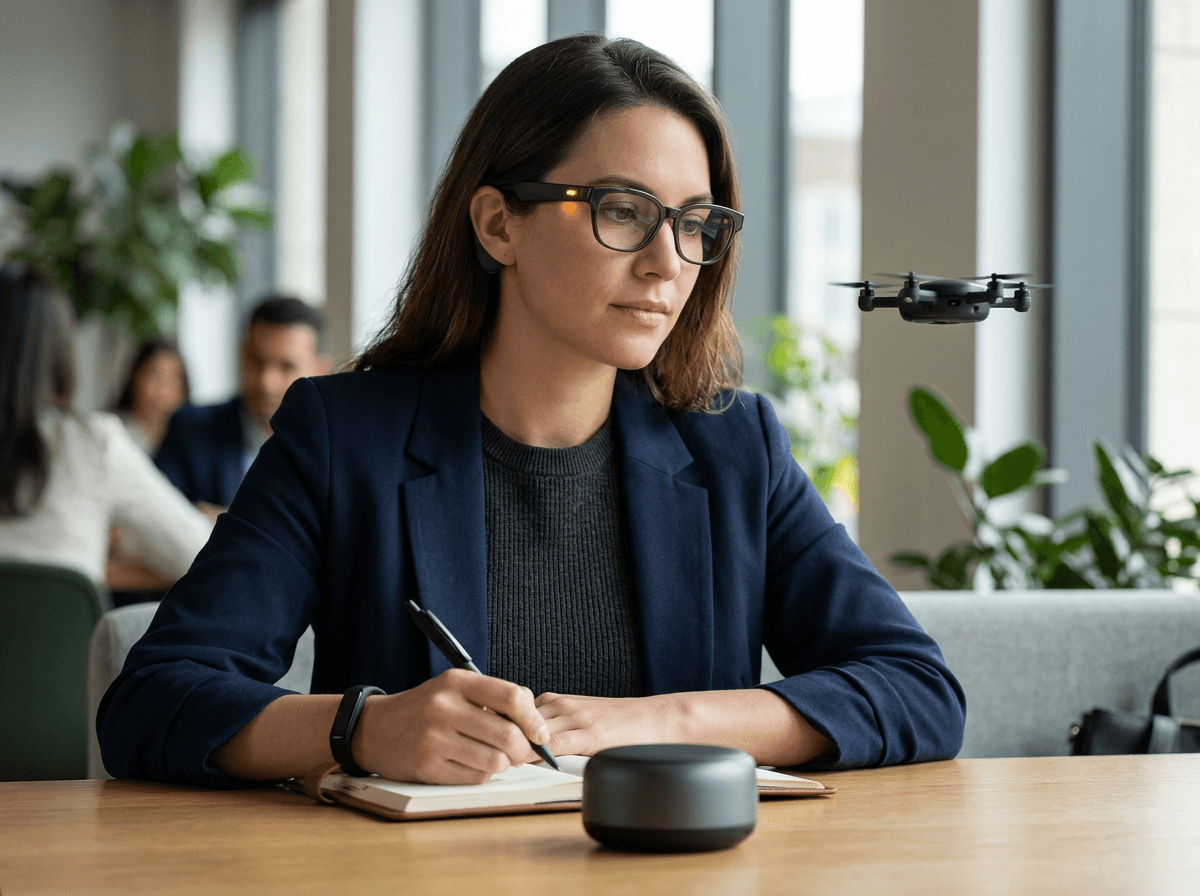
Prescription-ready glasses in partnership with established eyewear brands. The frame carries a forward-facing 12MP camera with an automatic mechanical privacy shutter - not a software switch, a physical one, visible from the outside. An amber LED on the right temple glows when the cameras are active. Bone-conduction audio emitters in both temples deliver audio to the wearer only, inaudible to bystanders. A minimal in-lens waveguide display in the right lens shows navigation, counters, and single-line confirmations. The display never renders anything that competes with the physical world for sustained attention. Battery: 14 hours. No facial recognition of third parties. The camera captures context for the wearer; it doesn't identify the strangers walking past them.
Component 2: The Cuff
A slim wristband, closer to a bracelet than a smartwatch. High-density EMG sensors read fine gesture and subvocalisation-correlated muscle signals. Haptic actuators deliver silent notifications via a tap pattern language learned over time. No screen, no speaker, no microphone. Its job is to read the body and deliver haptic output. Five days of battery life.
Component 3: The Node
A palm-sized object that sits on surfaces. At home it lives on a kitchen counter. In a meeting, it goes in the centre of the table, where its presence is visible and its purpose is declared - a shared AI context node that everyone in the room knows is active. It has a 360-degree microphone array, an upward-facing camera, and enough compute to run local language models. When you walk into the room, your Frame and the Node establish a local network and your personal context loads. When you leave, the Node forgets you. No cloud upload of conversations without explicit consent.
Component 4: The Stylus
An optional pen. It looks and writes like a quality ballpoint. Inside: an IMU for gesture recognition, a microphone for supplementary audio context, and Bluetooth. Tap it twice to activate note-taking mode; tap it once to switch to gesture input mode. In a meeting where speaking to your AI assistant would be inappropriate, the Stylus lets you interact silently through handwriting or small hand movements. It reads, to everyone watching, as someone taking notes.
Component 5: The Scout (mini drone)
A personal drone of around 8cm diameter and under 30 grams, charging wirelessly in a pocket-sized case. In active mode it hovers at roughly 1.5 metres, capturing context the glasses can't see. In privacy mode it lands immediately on voice command and wipes footage. Noise, battery life, and urban drone regulations all need further development, but it is a medium-term possibility. Ambient intelligence that occupies space, not just the body.
Privacy by design ...
No real-time facial recognition of third parties. Mechanical camera shutter visible from the outside. Amber LED mandatory when cameras are active. Primary audio output via bone conduction, inaudible to bystanders. Primary input via subvocalisation, inaudible to bystanders. All conversation data processed locally by default. Cloud sync requires explicit opt-in per session. Shared-space Node declares its presence visibly and can be deactivated by anyone in the room.
Closer than you think. Socially acceptable?
The technology is here. Meta is already shipping AI glasses with an in-lens display and gesture control. Google and Apple will follow in 2026. OpenAI's first home hub arrives in 2027. The AI models that will power these systems - contextually aware, conversationally fluent, fast enough to feel like thought - are pretty much in place.
The social and regulatory infrastructure is not close. The EU has drawn clear lines around biometric identification in public spaces; the UK and US have not. No jurisdiction has yet addressed the specific question of what an individual wearing an AI wearable owes to the people around them. No standard has emerged for how visible recording indicators should be, or what they should convey. No court has tested whether always-on ambient microphone capture of third-party conversations constitutes unlawful interception.
These questions will get answered. The answers will come either from regulators who get ahead of the technology, from courts responding to cases after harm has occurred, or from the market itself.
The deeper question isn't whether the technology is ready. It's whether the implicit deal it asks of society is acceptable. The deal is ... we get an extraordinarily powerful personal AI assistant ... everyone gets recorded by everyone else's AI assistant. That deal might be accepted. But acceptance isn't the same as consent, and an ecosystem built on acceptance rather than genuine social legitimacy is fragile in ways that will only become visible later.
The companies that get this right, treating the social contract as a design constraint rather than a PR problem, won't just make a better product. They will shape the future. A future that won't be about looking at a screen; it’s about the world becoming your interface.
We’re moving from "using" computers to "living with" them.
References
- The Interline (2026). Thirteen Years On, The Future of Wearables Still Looks Suspiciously Like Glasses. The Interline. January 2026.
- Meta (2025). New Meta Ray-Ban AI-Powered Display Glasses and Neural Band. Meta Newsroom. September 2025.
- UploadVR (2025). Next-Gen Ray-Ban Meta Glasses Could Recognize Faces in 2026. UploadVR. May 2025.
- Built In (2026). OpenAI's New Device: What We Know So Far. Built In. February 2026.
- CNBC (2025). Google to launch first of its AI glasses in 2026. CNBC. December 2025.
- Gizmochina (2026). Say Goodbye to "Hey Siri": Apple's Silent AI Is Coming, And It Can Read Your Lips. Gizmochina. February 2026.
- CRV Science (2026). AlterEgo: How Researchers Taught Wearables to Read Silent Speech. CRV Science. January 2026.
- Cornell University / ScienceDaily (2023). AI-equipped eyeglasses read silent speech. ScienceDaily. April 2023.
- VML Intelligence (2026). CES 2026 Trends: AI, Robotics and Longevity Tech. VML. January 2026.
- Patel, H. (2025). The Future Is Hands-Free: Voice, Touchless and Gesture Navigation Revolution. Medium. August 2025.
- GDPR Local (2026). UK CCTV Legislation: Laws and Compliance Requirements. GDPR Local. January 2026.
- Information Commissioner's Office (2025). Body Worn Video (BWV) — Guidance on Video Surveillance. ICO. Updated 2025.
- State of Surveillance (2025). Facial Recognition Laws Worldwide: Who Bans It, Who Builds It. State of Surveillance. December 2025.
- EU Artificial Intelligence Act (2025). Article 5: Prohibited AI Practices. artificialintelligenceact.eu. In force from February 2025.
