
Fast-Tracking the Future Workforce: How AI is bypassing the Education System ...
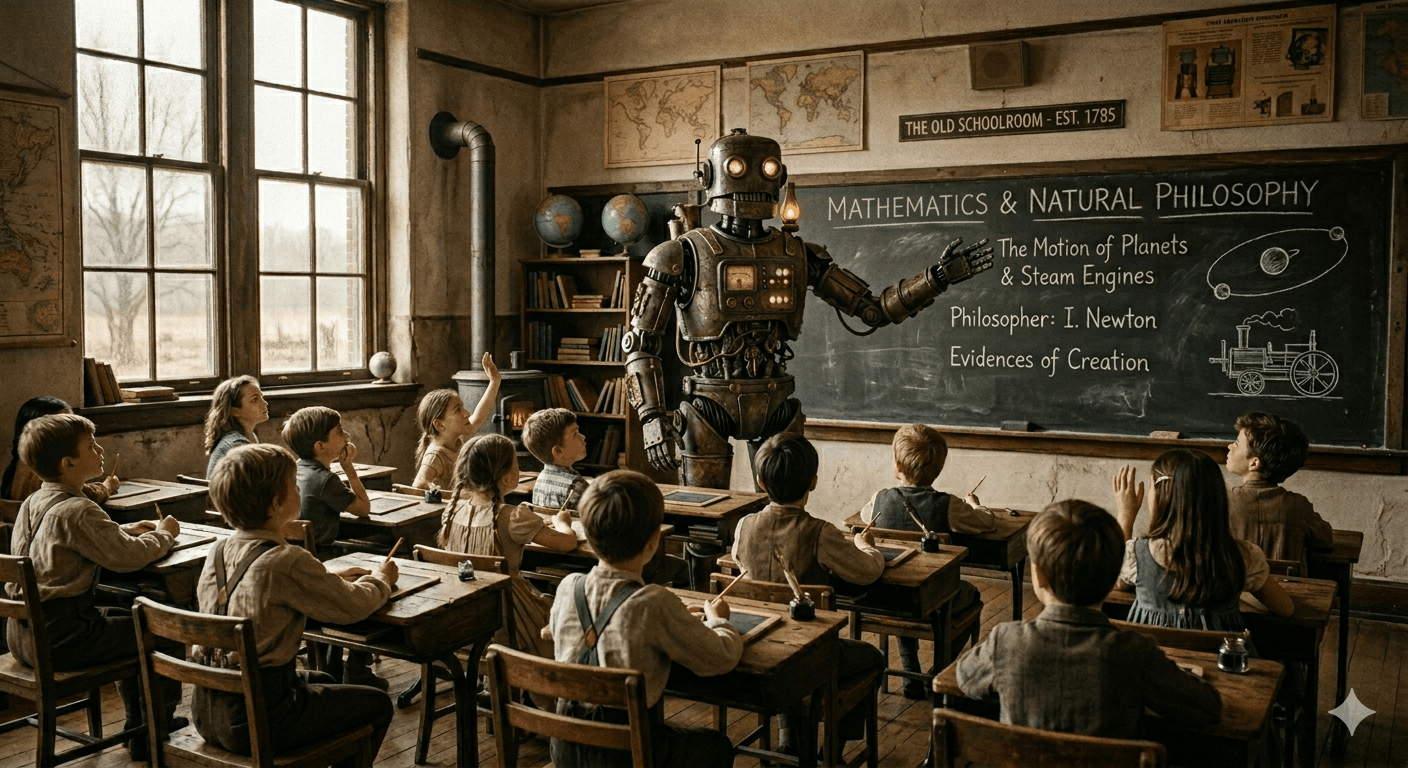

Here is the argument this article makes. AI is not simply changing education. It is creating the conditions under which significant numbers of young people will choose to route around it entirely. They will use AI to learn faster, more cheaply, and arguably more effectively than the traditional system allows. Forward-thinking employers will not merely tolerate this. Many will actively prefer it. And the institutions that do not adapt quickly enough will find themselves not reformed, but ignored.
That is the disruptive scenario. It may not happen uniformly, or immediately, or to every part of education equally. But the direction of travel is becoming hard to dispute. There are also some genuinely exciting possibilities on the other side. Once the content-delivery function of schools and universities is largely handled by AI, the physical space of education could be reimagined from the ground up. The school of the near future might spend far less time on curriculum delivery and far more time on the things AI cannot provide: physical health, mental wellbeing, cooking, social skills, sport, creative collaboration and human connection. For many children, that would be a better education than the one they are currently receiving.
This article works through the argument in stages: the AI revolution behind the current AI revolution; the structural inversion of what skills are economically valuable; what is actually happening in classrooms right now; why the threat to universities is more serious than they are admitting; why young people and employers may together route around the degree; what a reimagined education could look like; and what the financial case for change actually is.
The Curriculum Was Already Broken Before AI Arrived
Before examining where AI is taking education, it is worth establishing that the system being disrupted was already widely regarded as unfit for purpose by the people working inside it.
| Finding | Figure | Source |
|---|---|---|
| UK teachers: national curriculum not fit for purpose | 56% (19% further undecided) |
TES / YouGov[1] |
| US teachers: state of K-12 education has got worse in 5 years | 82% |
Pew Research[2] |
| UK primary teaching hours consumed by English and maths alone | 58% |
National Education Union[3] |
| US teachers: CPD they receive is irrelevant to their biggest needs | 48% |
Education Week[4] |
Curriculum satisfaction data, UK and USA, 2024–2025.
In the UK, a TES/YouGov poll found that 56% of teachers do not think the national curriculum is fit for purpose, with a further 19% undecided, meaning three quarters of the profession either rejects or doubts the framework they are required to teach.[1] A separate survey by the Headmasters' and Headmistresses' Conference found that teachers and senior leaders across state and independent schools believe the current system is failing to prepare young people to thrive in the 21st century, with assessments too narrowly focused and used for the wrong ends.[5] The National Education Union's primary curriculum survey found that 58% of all weekly teaching hours are consumed by English and maths alone, squeezing everything else out of the school day.[3] The government's own Curriculum and Assessment Review, which reported in November 2025, acknowledged that it had been more than a decade since the national curriculum was last properly reviewed, and the revised version will not reach classrooms until 2028 at the earliest.[6]
The picture in the United States is no better. A Pew Research survey found that 82% of US teachers say the overall state of public K-12 education has gotten worse in the past five years, and about half of all Americans say the public education system is going in the wrong direction.[2] On AI readiness specifically, only 11 US states required computer science for high school graduation as of 2024, with no national requirement for AI coursework at all, leaving the country with a chaotic patchwork of 50 different state-level approaches while other nations move with national purpose.[7]
The international contrast
China made AI education compulsory for every primary and secondary school student from September 2025, with over 1.83 million students in Beijing alone already enrolled.[8] Japan released its national AI education strategy in 2019 and has already trained 50,000 educators through its AI Education Accelerator Programme.[9] South Korea has AI coursework across all grade levels, backed by over $276 million in classroom digitisation funding.[10] The UK will finish debating its curriculum refresh in 2028.
Finland, which consistently outperforms both the UK and US in global rankings, redesigned its school day around human development and wellbeing decades ago. Finnish students spend the second-fewest hours in conventional lessons of any PISA participant, yet Finland consistently tops global assessments. Less structured delivery time, more human development, better outcomes. The formula is not mysterious. It has just been politically difficult to implement without the technological disruption that would force the question. That disruption has now arrived.
The Wave Behind the Wave: From Language Models to World Models
Most of the conversation about AI in education focuses on large language models: ChatGPT, Claude, Gemini and their successors. These are genuinely powerful tools. They process and generate text with impressive fluency. They summarise, explain, draft, give feedback and adapt. They are already reshaping how students work, whether institutions like it or not.
But the research frontier has moved on. The most important AI development of the next decade may not be a better language model. It may be something structurally different, and its implications for what humans need to learn are profound.
Yann LeCun, a Turing Award winner and founding figure of modern deep learning, spent twelve years leading Meta's AI research laboratory before departing in late 2025 to found Advanced Machine Intelligence (AMI) Labs, raising over a billion dollars in seed funding.[11] His argument is pointed: language models are "useful but fundamentally limited." They cannot truly reason or plan, because they lack any model of the world. They predict which words follow other words. They do not understand cause and effect, physical consequence, or spatial structure. As LeCun argued at the AI Action Summit in Paris in early 2025, scaling language models will not get us to genuine machine intelligence. He has suggested that in terms of genuine understanding, current AI systems are "dumber than house cats."[12]
What LeCun is building instead is what researchers call "world models": AI systems that learn how the physical world actually works. Not which words appear near other words, but how objects behave, how systems evolve, how actions produce consequences. His JEPA architecture learns abstract representations of reality from video and spatial data, the way a child learns about gravity not from reading about Newton but from watching things fall. Google DeepMind released Genie 3 in 2025, described as the first real-time interactive world model capable of generating persistent 3D environments. Fei-Fei Li's World Labs launched Marble shortly after. The race is on to build AI that reasons spatially and relationally, not just linguistically.[13]
This matters enormously for education, because of what it implies about human comparative advantage. The question is not just what can AI do, but what will AI do next, and what does that leave for us.
The Skills Inversion: What AI Is Making Cheap
Every major communication technology in human history increased the value of linguistic skill. Writing created a class of scholars whose value derived from their ability to encode knowledge in words. Print made literacy an economic necessity. The digital revolution turned clear written communication into a professional superpower. More reach always meant more reward for the ability to express ideas in words.
Generative AI inverts this for the first time.
A well-structured paragraph, a coherent argument, a persuasive essay: these are things that anyone can now produce with AI assistance, regardless of their native ability with language. The linguistic premium that drove centuries of educational investment is being rapidly commoditised. Businesses that once paid premium rates for skilled copywriters and communications professionals are already renegotiating the value of those skills. The same is happening in coding. Until very recently, the ability to write software was one of the most reliably well-compensated skills in the economy. AI coding assistants have changed that calculation substantially.
"The market value of writing and computer coding - once anchored by their difficulty - is plummeting as AI makes high-quality output cheap and instantaneous. Other areas will follow."
What AI cannot yet replace, and what may remain difficult for considerably longer, is the capacity to build and manipulate genuine mental models of complex dynamic systems. The ability to look at a tangled network of causes and effects and intuit the structural logic underneath it. The capacity to reason not in sentences but in shapes, flows, feedback loops and spatial relationships. The ability to hold a dynamic system in your head, turn it, stress-test it, and know where it will break.
Here is the uncomfortable implication. Education is currently optimising, at enormous expense and with enormous social pressure, for precisely the skills that AI is most rapidly commoditising. The essay is the central assessment instrument of the entire educational system from GCSE to doctorate. The essay is now largely AI-generatable. The system has not yet properly reckoned with what that means.
On AI detection: the arms race is over
The early detection logic was built on two measurable signals: perplexity, a measure of how syntactically predictable a piece of text is, and burstiness, the variation in sentence length that tends to distinguish human from machine prose. AI-generated text was statistically smooth in ways human writing was not. By 2026, that diagnostic window has largely closed.
The "Style-Matching" Killshot
The most direct killshot was style-matching. Students discovered that feeding a few hundred words of their own previous writing into a generative model and asking it to replicate their specific syntax, vocabulary, and even characteristic errors produced output that the leading detectors could not reliably distinguish from authentic work. The model is not writing generically; it is writing as you. Detectors trained on generic AI output have no meaningful purchase on a document that has been calibrated to a specific individual's prior writing history.
Failure of "Statistical Fingerprints"
The accuracy figures for the leading tools in 2026 tell their own story. Independent testing places real-world detection accuracy - across tools including Originality.ai, Copyleaks, GPTZero and Turnitin - in a range of roughly 65 to 90 percent under controlled conditions, with performance falling substantially when text has been lightly edited or paraphrased.[28] Research published in 2025 found that even modest humanisation edits to AI output can reduce detection confidence by 20 percentage points or more, while manual rewriting of flagged text can cut a tool's detection rate by roughly half.[28] The gap between vendor claims and independent test results has attracted the attention of the US Federal Trade Commission, which took action against one AI detection company in 2025 for advertising 98 percent accuracy on the basis of no credible supporting evidence.[29]
The false positive problem is serious and inequitably distributed. A landmark study from Stanford University found that seven widely-used detectors, while near-perfect on essays by native English-speaking students, misclassified more than 61 percent of TOEFL essays written by non-native English speakers as AI-generated, with 97 percent of those essays flagged by at least one detector.[30] The mechanism is structural: detectors score on perplexity, and the more constrained vocabulary and grammatical patterns characteristic of non-native writing produce low perplexity scores identical to those of AI output. In 2025, a Yale EMBA student born in France filed a lawsuit against his university after being suspended on the basis of an AI detection flag he denied, citing both false accusation and discrimination as a non-native English speaker - one of several such legal cases now documented in the US.[30]
The Shift to "Watermarking"
The field has attempted a structural escape from the detection arms race through watermarking. Google DeepMind's SynthID embeds an invisible cryptographic signature into text generated by Gemini at the moment of creation, shifting the problem from pattern analysis to provenance tracking. But Google's own technical documentation is explicit that SynthID is not a truth machine: detector confidence is substantially degraded when AI-generated text is thoroughly rewritten, translated, or subject to copy-paste modifications.[31] Peer-reviewed research published in 2025 demonstrated that paraphrasing and back-translation are sufficient to defeat SynthID-Text watermarks in many cases.[31] A student wishing to use AI to draft an essay and obscure that fact does not need any technical sophistication: generating a draft, rewriting it substantially, or simply retyping a paraphrased version, breaks the watermark signal entirely. SynthID also only detects content from Google's own models; a student using any other AI system generates output carrying no watermark at all.[31]
Institutional Surrender
The institutional response has been a quiet but accelerating withdrawal. By early 2026, at least a dozen universities - including Yale, Johns Hopkins, Northwestern, Vanderbilt, Curtin University and the University of Waterloo - had disabled AI detection tools entirely, citing unreliable accuracy and documented unfairness to particular student groups.[32] The institutions that have not disabled detection are increasingly treating a positive score as the beginning of a process rather than the end of one: requiring students to demonstrate authorship through document version history, iterative draft submissions, or brief oral follow-ups in which a student who genuinely wrote the work can explain its argument, and a student who did not cannot.[32] Research published in the British Journal of Educational Technology in 2025 found that even experienced academic markers were unable to reliably distinguish AI-generated submissions from student-written work in blind conditions, and that AI-generated submissions scored measurably higher on average - a finding that suggests the problem is not one that any software solution is likely to solve.[33] The conclusion is not comfortable: the final written product has become a commodity, and intent and process are the only things left that can be meaningfully assessed.
What Spatial and Structural Thinking Actually Means
The research backing for spatial skills as a cognitive foundation is substantial. Spatial ability is one of the strongest predictors of success in STEM disciplines, often outperforming verbal ability in longitudinal studies.[14] Visual-spatial skills measured at age five are direct predictors of arithmetic ability at age eight, independent of early mathematical knowledge.[15] A large meta-analysis of spatial training interventions found that these skills are genuinely teachable in young children and that the effects compound over time.[16] A 2024 study published in Learning and Instruction found bidirectional relationships between visual-spatial skills and mathematical performance in preschool, suggesting that spatial ability and mathematical reasoning build on each other iteratively from very early ages.[17]
Block play, sketching, three-dimensional construction, systems modelling, network mapping, flow diagrams and dynamic visualisation: these activities build cognitive infrastructure that transfers powerfully into mathematical reasoning, scientific thinking, and the kind of structural intuition that characterises the most valuable knowledge work. A research review published in Frontiers in Education found that hands-on exploration, visual prompts and gestural spatial training all significantly foster young children's spatial skills, with the malleability strongest in the youngest children.[16]
A curriculum redesigned around this understanding would treat diagram literacy, model-building, flow diagrams, network thinking and dynamic visualisation not as optional enrichment but as core intellectual disciplines, sitting alongside writing rather than subordinate to it. The essay as assessment tool need not disappear, but it would sit alongside spatial-relational equivalents that test genuinely different and increasingly more relevant cognitive capacities.
What Is Actually Happening in Classrooms Right Now
It is worth being honest about where we are, because the gap between the philosophical stakes and current reality is considerable.
In primary schools, AI largely means adaptive apps. Phonics practice, times-tables, personalised reading programmes. These tools are often well-designed and genuinely useful, offering the kind of individual adaptation that a teacher managing thirty children cannot realistically provide. A 2025 Microsoft survey found that 86% of education organisations now report using generative AI, the highest adoption rate of any sector surveyed.[18]
Real classroom example: AI as real-time learning support
Consider what is already technically possible today. An iPad placed on a desk, its camera pointed at a child's exercise book, could watch that child working through long division on paper. Computer vision systems can recognise handwritten mathematical working in real time, identify the stage the child has reached, detect the specific error they are making, and offer targeted support through an earpiece or on-screen prompt before the child has finished the problem. No waiting for the teacher to reach their desk. No misconception left to take root. The intervention is immediate, specific and invisible to the rest of the class. The component parts of this system exist today. The question is assembly and deployment.
In secondary schools and universities, the picture is more complicated. Students are using AI to write. A survey of university faculty published in early 2026 found that 74% believed generative AI was affecting the integrity and value of academic degrees for the worse, with only 8% expecting positive effects.[19] Detection tools are unreliable and increasingly obsolete. Research published in the British Journal of Educational Technology in 2025 identified what the authors called "metacognitive laziness" when students relied on AI assistance: less engagement with the actual process of thinking, greater focus on producing the required output.[20]
Teachers, by contrast, are enthusiastic adopters for their own professional work. Lesson planning, resource creation, marking: AI handles these tasks well. The system is, in short, using AI to do education more efficiently while leaving its underlying structure unchanged. Students outsource the written outputs the system values. The outputs are indistinguishable from human-produced work. Nobody quite knows what to do. This is not a stable situation. The pressure will build until something gives.
The University Question Is More Serious Than Universities Are Admitting
I want to use a personal example to make the university disruption argument concrete.
My daughter is studying philosophy at degree level. I ran an experiment. I asked ChatGPT to construct a degree-level philosophy syllabus drawing on the best curricula from leading UK universities. In under a minute it produced something genuinely impressive: coherent, rigorous, well-structured, drawing on exactly the canonical and contemporary sources a serious programme would use. My daughter, three years into the subject, was taken aback by its quality. The model then offered to design one of the modules in detail, complete with reading lists and pedagogical framing. Again, impressive.
I then took several pieces of work she had submitted in previous years and fed them to Claude, Gemini and ChatGPT, asking for detailed academic feedback. What came back was startling. Not because it was harsh, but because it was extraordinarily detailed, genuinely engaged with the arguments, and more pedagogically useful than any feedback she had received from her lecturers. Immediate, specific, personalised, intellectually serious.
Now ask the obvious question. What exactly justifies asking a young person to take on more than £60,000 in debt for a course providing a few contact hours per week, across perhaps thirty weeks per year, when AI can provide richer feedback more quickly, when the curriculum can be mapped in seconds, and when a motivated self-directed learner could cover equivalent intellectual ground in two years rather than three or four?
There are genuine answers. The social experience of university, the relationships formed, the exposure to different minds and ways of thinking, the experience of sustained independent intellectual effort: these are real and not replaceable by any AI tutor. Laboratory work, clinical placements, studio practice and ensemble performance require physical presence and expert human guidance. The degree as a credential still functions as a signal in labour markets, at least for now.
But the signal argument is weakening fast. A 2025 NBC News poll found that 63% of Americans now believe a four-year degree is not worth the cost, a dramatic shift from a decade ago.[21] UK sentiment is moving in a similar direction. Research published in Frontiers in Education in 2025 found that credential monopolies previously held by universities are being actively eroded by AI-enabled micro-credentials and alternative verification systems, with employers in several sectors already recognising modular certifications as equivalent to degrees.[22]
The Graduate Unemployment Crisis Makes This Worse
The traditional argument for the degree, that it is the essential gateway to good employment, is also under growing empirical pressure, particularly in the UK.
| Indicator | Figure | Source |
|---|---|---|
| UK recent graduate unemployment (2020 cohort onwards) | 12.7%, over 96,000 per year |
HESA / StandOut CV[23] |
| UK graduates not in full-time employment 2 years after graduating | 4 in 10 |
Indeed / The Boar[24] |
| UK 16–24 year olds NEET (September 2025), highest since 2011 | 948,000 |
Trade Union Congress[25] |
| Graduate unemployment 15 months after graduating (2025/26 report) | 6.2%, up from 5.6% |
Prospects Luminate[26] |
UK graduate labour market data, 2024–2025.
By September 2025, the Trade Union Congress reported that 948,000 16 to 24 year olds were not in education, employment or training in the UK, the highest number since 2011, when the financial crisis was the cause.[25] Employment website Indeed stated in mid-2025 that UK graduates were facing the worst job market since 2018, with graduate job vacancies having fallen by a third.[24] PwC announced in September 2025 that it would hire 200 fewer university leavers than usual. Three Oxbridge graduates told The Times that summer that they could not get "a good job."
The combination of rising debt, falling job availability, and AI-driven disruption to the very roles graduates have traditionally filled creates a powerful incentive for the next generation to ask whether the traditional route still makes sense. The answer, for a growing number of them, is going to be no.
The Fast-Track Generation and the Employers Who Will Welcome Them
Think about this from an employer's perspective. A large company currently spends considerable resource recruiting graduates, running induction programmes, and spending the first year essentially re-educating people who have just spent three or four years in institutions not primarily focused on the skills the company needs. It tolerates this because the degree serves as a filtering mechanism.
Now consider the alternative. It is easier than it has ever been for a substantial company to design and run its own education and entry scheme. AI tutoring systems can provide genuinely world-class instruction, personalised to the individual, at a fraction of university cost. A company could partner with an assessment body to provide verified credentials, design a two-year programme covering exactly the skills it values, and recruit at sixteen or eighteen directly into that pathway. The learner gets a salary or stipend rather than a debt. The employer gets people shaped to their actual requirements. The degree is bypassed entirely.
The efficiency argument
An individualised, AI-powered degree-equivalent programme could realistically be completed in two years rather than three or four because it eliminates every inefficiency built into the traditional model: no lectures pitched at the wrong level, no waiting for the slowest student, no one-size-fits-all assessment calendar, no repeating in year two what was covered in year one. The learner moves when they are ready. They demonstrate mastery when they have it. AI-led personalised learning is, in the most precise sense, the ultimate form of lesson differentiation. Every moment of learning time is active and appropriately calibrated.
This is not a far-fetched scenario. It is, in various forms, already happening. The question is whether it will remain a niche option for a small number of school leavers or become a mainstream alternative. The answer depends largely on how quickly the labour market signals shift. When the first major employers begin publicly stating a preference for AI-educated self-directed learners over standard graduates, the incentive structure changes very rapidly indeed.
For many young people from lower-income backgrounds, this shift could be genuinely liberating. The idea that you must take on enormous debt to access a credible pathway to a good career is a relatively recent and, in historical terms, a rather strange arrangement. AI may be about to make it optional.
What Schools Could Actually Become
Here is perhaps the most interesting possibility buried in all of this disruption. If AI delivers the curriculum, what are schools actually for?
The current school model allocates the vast majority of time to content delivery: teaching children things, testing whether they have retained them, repeating the process. A huge proportion of teacher time and energy goes into lesson preparation, explanation, differentiation and marking. These are all things AI can do, and in terms of personalisation, AI can do them better than any single teacher managing thirty children across multiple subjects simultaneously.
AI-led personalised learning is the ultimate form of lesson differentiation. Every child gets instruction pitched at exactly the right level. Every child progresses at their own pace. Every child receives immediate, specific feedback. The child who is ahead in mathematics is not held back by the class pace. The child struggling with reading gets targeted support without the stigma of being visibly pulled out of the group. The child with dyslexia gets tools adapted to her specific processing style. Research consistently shows that mastery-based pacing, where a student moves on only when they are ready, dramatically outperforms calendar-paced whole-class instruction. That saved time can be directed elsewhere.
If the content-delivery function of schools is increasingly handled by AI, the school building and the school day are freed up for everything that AI cannot provide. The physical education programme could be genuinely comprehensive, treating physical fitness, movement and body literacy as serious educational priorities rather than timetable fillers. Schools could teach cooking and nutrition as a full discipline, not a fortnightly slot in food technology. Mental health and emotional literacy could have real curriculum time. Social skills, conflict resolution, collaborative working, the ability to build trust with strangers: these are learnable capacities that require human interaction to develop and that matter enormously for adult life.
Finland has been pointing in this direction for years. Finnish students spend the second-fewest hours in conventional lessons of any PISA participant, leaving ample time for teachers to develop their practice and for students to pursue activities outside formal instruction. Yet Finland consistently outperforms countries that spend far more time drilling curriculum content. Less structured delivery time, more human development, better outcomes.
This is not a dystopian vision of children staring at screens while algorithms manage their development. It is the opposite: schools as genuinely human spaces, because the machine has taken over the parts of education that are fairly mechanical. The lecture, the worksheet, the standardised test: these are low-quality human activities. The coaching conversation, the team challenge, the creative project, the outdoor expedition: these are high-quality human activities. AI makes the first category redundant and the second category more accessible.
What This Is Worth: The Financial Case
The economic case for the fast-track model is significant and largely overlooked in policy discussions that focus on the costs of AI adoption rather than the costs of not changing. The table below sets out conservative estimates for both the UK and USA.
| Measure | UK | USA |
|---|---|---|
| Typical debt at graduation (traditional path) | ~£55,750 |
avg $37,000 student debt plus living costs |
| Age entering workforce: traditional | 21–22 |
22–23 |
| Age entering workforce: AI fast-track | 18–19 |
18–19 |
| Extra productive working years gained by age 65 | 3–4 years |
4 years |
| Estimated lifetime financial advantage (individual) | £180,000–£220,000 |
$270,000–$330,000 |
| Estimated annual GDP gain at 20% fast-track adoption by 2035 | £11bn+ per year |
$80bn+ per year |
Conservative modelling based on avoided debt, foregone earnings during study, and additional productive working years. All figures in 2025 prices. Illustrative orders of magnitude, not a policy forecast.
The UK individual figure reflects avoiding approximately £55,750 in tuition and maintenance debt, entering the workforce at 18 to 19 rather than 21 to 22, and gaining three to four extra productive working years by age 65. The US figure is larger because four-year college costs are higher and the debt burden more severe, with average student debt at graduation running at around $37,000 even before living costs are counted. The national figures assume a 20% fast-track adoption rate among the annual graduate cohort and treat each additional productive year as worth approximately the mean graduate salary. The economic argument for accelerating this transition is substantial and almost entirely absent from the current policy debate.
A Note of Caution, and a Challenge
None of this is inevitable, and some of it requires serious qualification.
The risk of widening inequality is real. Access to quality AI tutoring, fast internet connections and the kind of parental support that helps a young person navigate a self-directed learning pathway is not evenly distributed. A world in which confident, well-resourced young people bypass the degree while others remain trapped in the traditional system would be a worse world, not a better one. Any serious policy engagement with this agenda has to grapple with that risk directly and design for equity from the outset, not as an afterthought.
The social and developmental case for school and university is also not trivial. The research on belonging, peer relationships and the experience of living alongside people whose minds work differently from yours is genuinely important. These are not things you get from an AI tutor, however sophisticated. The challenge is not to eliminate the human institution but to redesign it around the things that human institutions do that AI cannot.
The deeper challenge is to the institutions themselves. Those that have defined their purpose as the delivery of curriculum content will find that purpose eroding quickly and visibly. Those that redefine their purpose as the development of human capacities, the building of communities of inquiry, and the cultivation of the spatial and structural thinking that the AI age demands: those institutions have a genuinely exciting future ahead of them.
The question is which institutions have the imagination and the urgency to make that shift before the fast-track generation makes them irrelevant. Right now, the betting would have to be on the fast-track generation.
References
- TES / YouGov (2020). Teachers reject national curriculum as 'not fit for purpose'. Times Educational Supplement. 56% of teachers do not think the national curriculum is fit for purpose; 19% undecided.
- Pew Research Center (2024). About half of Americans say public K-12 education is going in the wrong direction. 82% of US teachers say the state of public K-12 education has gotten worse in the past five years.
- National Education Union (2024). Primary Curriculum Survey. NEU. 58% of all weekly primary teaching hours devoted to English and maths, squeezing other subjects out of the school day.
- Education Week / EdWeek Research Center (2024). 5 Key Insights Into America's Teachers. March 2024. 48% of US teachers say the professional development they receive is irrelevant and not connected to their biggest needs.
- Headmasters' and Headmistresses' Conference (HMC). HMC survey finds curriculum and assessment is no longer fit for purpose. Survey of ~800 teachers and senior leaders across state and independent sectors.
- UK Department for Education (2025). Curriculum and Assessment Review: Final Report: Government Response. November 2025. Revised national curriculum to be published 2027; first teaching from 2028.
- Future of Being Human (2025). AI in Education Strategies: US vs China. April 2025. Only 11 US states required computer science for high school graduation as of 2024; no national AI coursework requirement.
- Xinhua / The AI Track (2025). China Mandates AI Education Nationwide by 2025. Rollout from September 2025; Beijing alone: 1,400+ schools, 1.83 million students in compulsory AI curriculum.
- UNESCO-ICHEI (2025). Integrating Generative AI into Japanese Higher Education. Japan AI Strategy 2019; MEXT certification system for maths, data science and AI introduced 2021; AI Education Accelerator Programme targeting 50,000 educators by 2025.
- Center on Reinventing Public Education (2025). Shockwaves and Innovations: How Nations Worldwide Are Approaching AI in Education. South Korea: AI coursework across all grade levels; $276m+ allocated for classroom digitisation.
- HPCwire / AIwire (2026). Yann LeCun's AMI Secures $1B Seed to Develop AI World Models. March 2026. AMI raised $1.03 billion seed round at $3.5bn valuation to build AI systems that understand the physical world, have persistent memory, and can reason and plan.
- MIT Technology Review (2026). Yann LeCun's new venture is a contrarian bet against large language models. January 2026. LeCun: LLMs "limited to the discrete world of text"; Moravec Paradox; world models as the path to genuine intelligence.
- Scientific American (2026). The next AI revolution could start with world models. January 2026. Covers DeepMind Genie 3, World Labs Marble, LeCun's JEPA architecture, and DreamerV3 world-model research.
- Wai J., Lubinski D., Benbow C.P. (2009). Spatial ability for STEM domains: Aligning over 50 years of cumulative psychological knowledge solidifies its importance. Journal of Educational Psychology, 101(4), 817–835.
- Poltz N. et al. (2025). Visual-spatial skills and children's math development. Learning and Instruction. Visual-spatial perception at age 5–6 is a direct predictor of arithmetic ability at age 8.
- Cheng Y. et al. (2020). Is Early Spatial Skills Training Effective? A Meta-Analysis. Frontiers in Psychology. PMC7485443. Spatial skills malleable in young children; hands-on exploration and visual prompts most effective; malleability strongest at youngest ages.
- Edutopia (2022). How to Foster Spatial Skills in Preschool and Elementary Students. March 2022. Research synthesis on spatial skills, STEM outcomes, and bidirectional development with mathematical reasoning.
- Microsoft / IDC (2025). 2025 AI in Education Report. 86% of education organisations now use generative AI, the highest adoption rate of any sector surveyed.
- Elon University / Penta Group Intelligence (2026). Survey of university faculty, October–November 2025. 74% say GenAI will affect academic degrees' integrity and value for the worse; only 8% expect positive effects. The EDU Ledger, January 2026.
- Fan Y. et al. (2025). Beware of metacognitive laziness: Effects of generative artificial intelligence on learning motivation, processes, and performance. British Journal of Educational Technology, 56(2), 489–530. doi:10.1111/bjet.13544
- UPCEA (2025). AI in Higher Ed Will Come Slowly, Until All of a Sudden! December 2025. Cites NBC News poll, November 2025: 63% of Americans say a four-year college degree is "not worth the cost."
- Ahmed S.A. (2025). Reimagining Education in the Coming Decade: What AI Reveals About What Really Matters. Frontiers in Education, 10. doi:10.3389/feduc.2025.1699106
- StandOut CV / HESA Graduate Outcomes Survey (2025). UK Graduate Statistics and Employment Rates. Recent graduates (2020 onwards): unemployment rate 12.7%, over 96,000 per academic year.
- The Boar / Indeed (2025). Uni leavers face unemployment crisis as graduate jobs in the UK fall by a third. September 2025. Four in 10 graduates not in full-time employment two years after graduating; worst graduate job market since 2018.
- Trade Union Congress (2025). UK youth unemployment statistics, September 2025. 948,000 16–24 year olds not in education, employment or training (NEET), the highest number since 2011.
- Prospects Luminate (2025). What Do Graduates Do? 2025/26. 6.2% of UK-domiciled graduates unemployed 15 months after graduating, up from 5.6%; 56.4% in full-time work at 15 months.
- UK Department for Education (2025). Graduate Labour Market Statistics, Calendar Year 2024. Explore Education Statistics. Released March 2025.
- Walter Writes / Supwriter independent benchmarks (2026). Are AI Detectors Accurate in 2026? Accuracy ranges from 65–90% across leading tools under controlled conditions; paraphrased or humanised AI content reduces detection accuracy by 20% or more; manual rewriting can reduce Copyleaks detection from ~77% to ~40%. Cross-referenced with Supwriter's structured evaluation of 180+ samples, April 2026.
- Originality.ai (2025). AI Detection Accuracy Studies — Meta-Analysis. Covers FTC enforcement action (2025) against Workado / Content at Scale for advertising 98% detection accuracy without supporting data; independent testing showed accuracy of 53% on general-purpose content. FTC warning: "make sure that your claims accurately reflect the tool's abilities and limitations."
- Liang W. et al. (2023). GPT detectors are biased against non-native English writers. Patterns, 4(7), 100779. Stanford University. Seven AI detectors misclassified 61.3% of TOEFL essays by non-native English speakers as AI-generated, while achieving near-perfect accuracy on US eighth-grade essays; 97.8% of TOEFL essays flagged by at least one detector. Related: Yale student lawsuit (2025) documented in Flagler College / GovTech, March 2025.
- Han X. et al. (2025). Robustness Assessment and Enhancement of Text Watermarking for Google's SynthID. arXiv:2508.20228, revised October 2025. SynthID-Text vulnerable to paraphrasing, copy-paste, and back-translation attacks, significantly degrading watermark detectability. Google's own documentation acknowledges detector confidence is greatly reduced when text is thoroughly rewritten. SynthID only detects content generated by Google's own models. See also: Google AI for Developers, SynthID Text technical documentation, 2025.
- HumanizeThisAI / WriteBros.ai (2026). Should Universities Use AI Detection? and AI University Policies 2026. At least 12 elite universities — including Yale, Johns Hopkins, Northwestern, Vanderbilt, Curtin University (January 2026), and the University of Waterloo — have disabled AI detection tools, citing inaccuracy and fairness concerns. Institutional shift toward process-based assessment: draft version history, staged submissions, and oral follow-up components.
- Kofinas A. et al. (2025). The impact of generative AI on academic integrity of authentic assessments within a higher education context. British Journal of Educational Technology, 56, 2522–2549. doi:10.1111/bjet.13585. Experienced markers unable to reliably distinguish AI-generated from student-written work in blind conditions; AI-generated submissions scored on average more than half a classification boundary higher than genuine student work.
