
Earlier Springs and Later Autumns: Surely a longer growing season is a good thing?
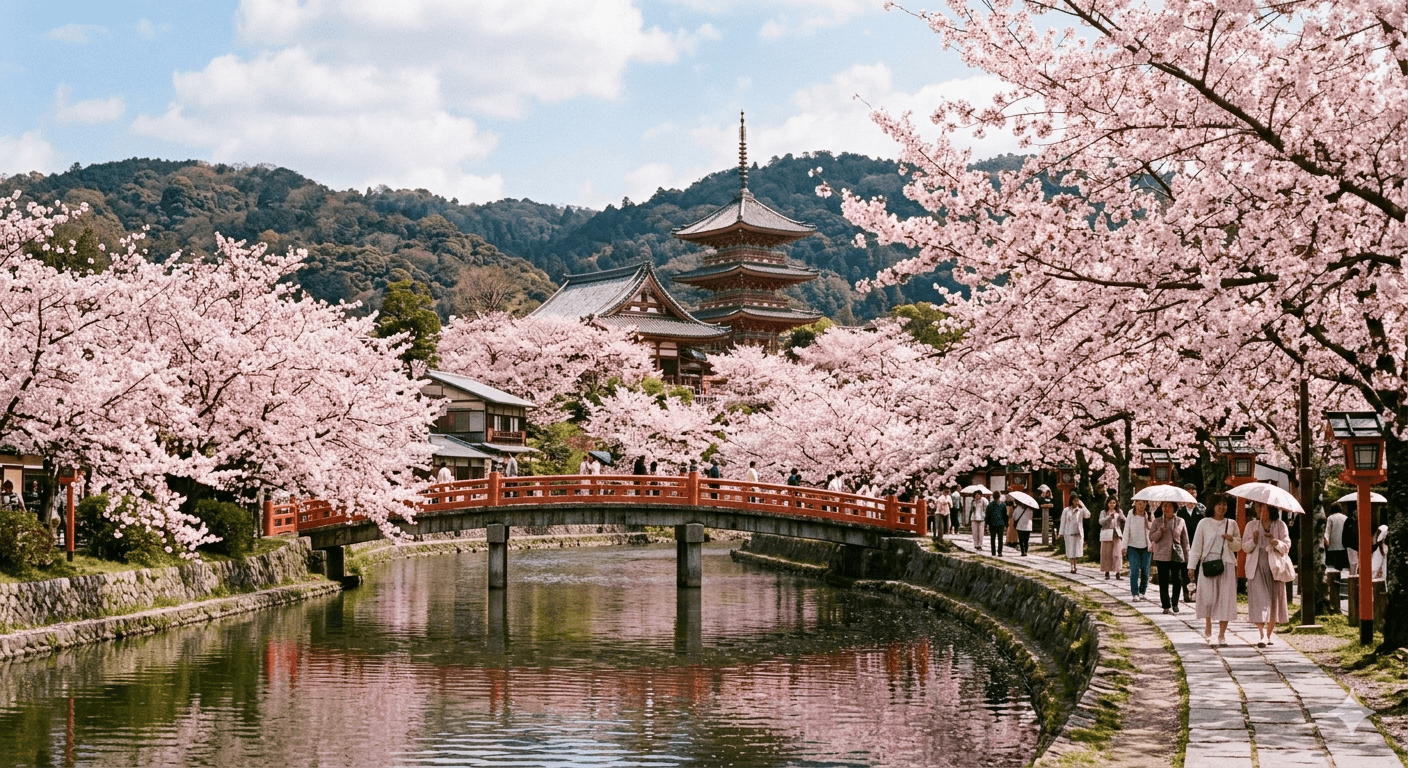

Everyone knows spring is arriving earlier. It gets talked about every March when the blossom comes out a week ahead of schedule, when the swallows show up too soon, when the farmers start worrying about a late frost killing crops that woke up before they should have. But the other end of the shift barely makes the news. Autumn is arriving later too, and by roughly the same amount. Across 131 temperate regions worldwide, every single one now has a later autumn than its historical baseline. All 131 out of 131. The spring figure is impressive: 126 out of 131 regions have earlier springs. The autumn figure is absolute.
Our Shifting Seasons page pulls together the longest and cleanest records we have to show how the calendar is changing — Kyoto's 1,200-year cherry-blossom archive, the Northern Hemisphere snow record, a live US spring tracker and the US growing season going back to 1895. The pattern is consistent across all of them. What's less obvious is whether a longer warm season is actually a good thing.
Two Ends Moving at Once
The mean spring advance across 131 temperate and continental regions is –9.0 days. The mean autumn extension is +8.5 days.[1] Add them together and the warm season is more than two and a half weeks wider than it used to be. That's not a seasonal shift — it's a seasonal stretch, being pulled from both ends simultaneously.
The autumn signal is actually cleaner than the spring one. Spring is noisier: a single late cold snap can push the crossing date back in a given year, which is why you occasionally get an outlier region bucking the trend. Autumn is more consistent. Temperatures decline more gradually, the signal is smoother, and the data from every temperate and continental region on the planet is pointing the same way.
Where the shift is biggest
Polar regions are shifting fastest: spring has advanced by around 17 days and autumn has extended by nearly 18, adding more than a month of warm season. Temperate regions (Köppen C) show around 10.8 days of spring advance and 11 days of autumn extension. Iceland leads both the spring and autumn rankings globally, while Northern Ireland, the English Midlands and South East England all appear in the top eight for autumn extension at around +15 days.
1,200 Years of Evidence From Kyoto
The Kyoto cherry blossom record gives us the longest view. Court diaries, monastery logs and weather observations have tracked the city's peak bloom date almost every year since 812 CE — more than 1,200 years of continuous observations from a single place, recording a single biological event that responds directly to winter and spring temperatures.[2]
Before 1850, the long-term average full-bloom date was April 15. The recent 30-year mean is April 5. A shift of 10.7 days, visible in a scatter plot spanning more than a millennium, with the trend accelerating sharply from the late 20th century onward. The earliest bloom in the entire record? 2021. March 26.
What makes the Kyoto data so scientifically valuable is that it's not a proxy. It's a direct observation written down by people who cared about the date because the blossom carried cultural significance. The warming signal embedded in that cultural tradition is now impossible to ignore.
Spring Snow Is Collapsing
Satellites have mapped Northern Hemisphere snow cover every week since late 1966. Winter snow extent has held up reasonably well — the recent 10-year anomaly is just –0.6% against the 1981–2010 baseline. Spring is a completely different story. Spring snow cover has dropped by –4.5% in the recent decade. Against the first 10 years of the satellite record, spring snow lost is –9.2 percentage points.[3] The meltout happens weeks earlier now, across vast areas.
Darker land freed of snow earlier in the year absorbs more sunlight, which warms the region faster, which drives earlier meltout the following year. A feedback loop, written in satellite imagery and updated monthly. The Northern Hemisphere snow-free season has grown from 187 days to 204 days since the early 1970s. Seventeen extra days when the ground is bare and absorbing heat.
The US Growing Season Is Up 17 Days. Is That Good?
The EPA tracked the frost-free growing season across the contiguous 48 states from 1895 to 2020.[4] The recent 10-year average is +11.7 days longer than the 1895–2020 mean. Compared to the first 30 years of the record, the gain is +17.2 days. The bar chart of annual anomalies makes the trend visual: mostly shorter-than-average seasons through most of the 20th century, then a decisive flip from around 1980 onward, with bars getting taller almost every year through the 2010s.
The instinct is to read this as straightforwardly good news for farmers. More frost-free days means more time to grow crops, more options for what to plant, potentially two harvests from a plot that used to support one. At higher latitudes — Canada, Scandinavia, Scotland — land that was previously marginal for certain crops is becoming viable. That's a real benefit.
But the picture gets complicated fast.
The false spring problem
Earlier springs don't arrive smoothly. Warm spells in February and March trigger early bud break and blossom in fruit trees and crops, which then get hit by a late frost in April. The plant thinks winter is over; the calendar disagrees. This "false spring" risk is increasing in Europe and East Asia in particular, where plant species are less well adapted to managing the mismatch. A 2020 PNAS study found that late-spring frost damage to forests has increased across 35% of European forest area and 26% of Asian forest area over recent decades.[5] In North America the figure is lower, around 10%, partly because species there evolved with more variable spring conditions. But the risk is real everywhere.
More generations of pests
A longer warm season doesn't only benefit crops. Insect pests complete their life cycles faster in warmer conditions and can fit more generations into a single season. Species that previously couldn't overwinter at higher latitudes are moving north. A longer growing season means more pest pressure, more pesticide use and more management complexity.[6] Weeds benefit too — warmer temperatures and elevated CO₂ often favour weed growth over crop growth.
Crops mature faster, not just longer
Warmer temperatures accelerate crop development, meaning individual crops mature faster than they used to. A longer frost-free window doesn't automatically translate into a longer period for yield establishment — the plant may simply rush through its growth stages and reach harvest earlier, without necessarily producing more.[7] Research from Our World in Data and the IPCC suggests that across major crops globally, climate change has acted as a brake on yield growth — maize yields, for example, might be 4–5% higher today if temperatures hadn't risen.
The honest answer
A longer growing season is a partial benefit at best. Farmers at high latitudes gain real new options. But those gains come bundled with more pest pressure, higher irrigation demand, false spring frost risk and crops that rush through growth stages faster than their biology was designed for. The EPA's own summary puts it plainly: overall warming is expected to have negative effects on yields of major crops, even though individual locations may benefit.
What This All Points To
The Shifting Seasons data comes from places that have nothing in common except the direction their numbers are pointing. A Japanese monastery recording blossom dates in the 9th century. A satellite counting snow pixels over Manitoba. A thermometer in Iowa noting whether frost fell overnight. A phenology network's thermal model updating daily on a server somewhere in the US. Different methods, different centuries, different continents.
Same direction. Every one of them.
The autumn signal is the one worth sitting with. It doesn't get the attention spring does, but a world where 131 out of 131 regions are getting later autumns is a world where the warm season is being stretched at both ends simultaneously. That has consequences for ecosystems, agriculture and energy systems that we're still working out — and a longer growing season turns out to be a much more complicated gift than it first appears.
Explore the full interactive analysis — including data for your country, US state, or UK region — at 4billionyearson.org/climate/shifting-seasons.
References
- Berkeley Earth / Our World in Data / NOAA NClimDiv / Met Office HadUK-Grid (various years). Country, US state and UK regional monthly temperature records. Seasonal shift analysis: baseline = first 30 complete years on record vs most recent 10. Warm-season metrics use 1951–1980 vs 2001–2024. Köppen codes follow Peel, Finlayson & McMahon (2007). Rainfall data: World Bank CCKP (CRU TS 4.08, 1901–2023).
- Aono, Y. & Kazui, K. (2008). Phenological data series of cherry tree flowering in Kyoto, Japan, and its application to reconstruction of springtime temperatures since the 9th century. International Journal of Climatology 28, 905–914. Extended by Aono & Saito (2010), via NOAA NCEI Paleoclimatology. Recent decade extended from JMA Kyoto sakura observation records.
- Rutgers University Global Snow Lab (NOAA NESDIS satellite analyses). Northern Hemisphere Snow Cover Climatology. Climatology baseline 1981–2010. Updated monthly.
- US Environmental Protection Agency / Kunkel, K. (2021). Climate Change Indicators: Length of Growing Season. Coverage: contiguous 48 states, 1895–2020. EPA indicator updates suspended after April 2021.
- Zohner, C.M. et al. (2020). Late-spring frost risk between 1959 and 2017 decreased in North America but increased in Europe and Asia. Proceedings of the National Academy of Sciences 117(22), 12192–12200.
- Skendžić, S. et al. (2021). The Impact of Climate Change on Agricultural Insect Pests. Insects 12(5), 440.
- Ritchie, H. (2024). Crop yields have increased dramatically in recent decades, but crops like maize would have improved more without climate change. Our World in Data.